
There’s a familiar cry: “AAAHHHH a wasp!!!!!!” as they start to run away.
And then there’s my curious response: “Ooh! What kind? I want to see!” as I eagerly go towards it.
Spring is here, and the flying, buzzing, stinging bugs have appeared in full force around the WonderWild cabin. I got skeptical looks from the kids the first time they saw me get excited about a bug. Then just a couple of weeks later they sat enraptured as we all peered closely to watch a paper wasp work on her new nest.
I don’t think of myself as a person who loves bugs. Some of them are mean, some are creepy, and I don’t want any of them to unexpectedly appear in my personal space. But over time I’ve come to see that compared to other people, I apparently LOVE bugs. I guess at the end of the day, they’re just one more kind of animal that shares this world with me, and my innate curiosity wins out over any initial unease.
So gather round, and I’ll tell you a little bit about the wasps and bees we share space with here at WonderWild.
The Difference Between Wasps and Bees
Say you’re minding your own business (says you!) and find yourself in a sudden swarm of maybe-stingy bugs.
Quick! What should you do? Freeze?! Run?!
If you’re surrounded by bees, you should freeze, then move slowly away from the crowd. If you’re surrounded by wasps, you should make a run for it!
It turns out bees and wasps have different personalities and different habits when it comes to whether or not they’re about to sting you. It makes sense to learn a bit about which is which!
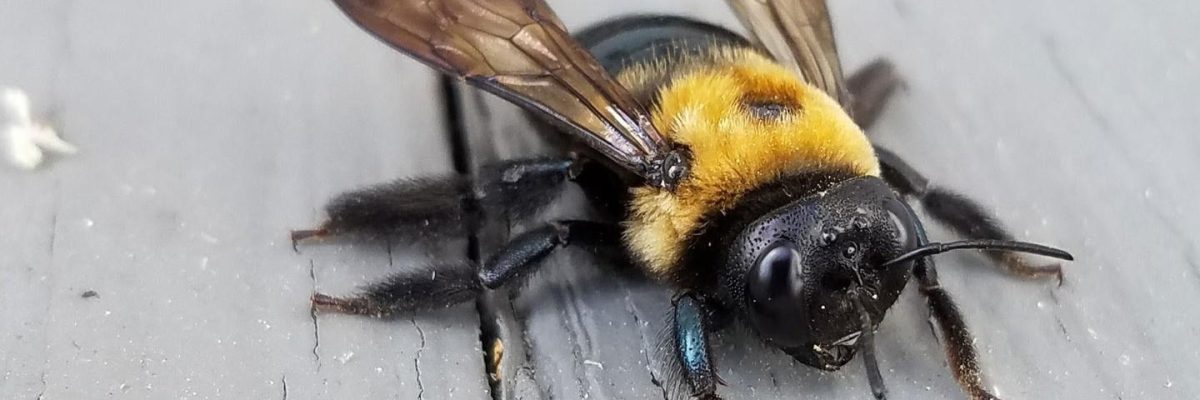
Bees are fat, fuzzy, and move slowly with their feet tucked up. I like to call them flying teddy bears. Wasps are smooth and sleek, often with a “waist” between their thorax and abdomen. They fly with their legs dangling.
Bees are full-time pollinators, feeding exclusively on nectar and pollen. Wasps are typically omnivores, eating other bugs, fruit, and scavenging for meat (and a bit of pollinating on the side.)
Bees are chill and have no interest in you. They’ll only sting you with very good reason, usually because you ran into them by stepping on them or swatting at them. Bees can only sting once, which kills them.
Wasps are more likely to take offense at your presence. While they’ll also only sting you for a reason, they’ve got way more attitude and seem ready to pick a fight. Plus, they come armed: they can sting you multiple times.
Carpenter Bees
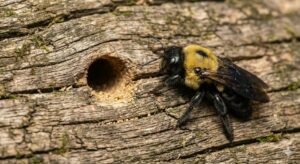
The most common bee we see at WonderWild is the Eastern carpenter bee. Carpenter bees build their nests in wood, which is probably why they like our little wooden cabin! Their nests are round with tunnels where they lay eggs. They mate in the spring and lay eggs in July. They survive mostly on nectar and pollen.
The males won’t sting people – they don’t have the anatomy for it – although they’ll fly close to people and buzz loudly around them. The females can sting, even multiple times, which is unusual for bees. However, they’re unlikely to sting unless you touch them.
When I see a carpenter bee near me I say, “Hello, bee!” and continue talking to them until they fly off. I want the kids to see that it’s okay to be calm and friendly with bees. I appreciate their slow flying, which lets me get a good look at them while we chat.
Paper Wasps
Our most common wasps are paper wasps. We have common paper wasps and red paper wasps.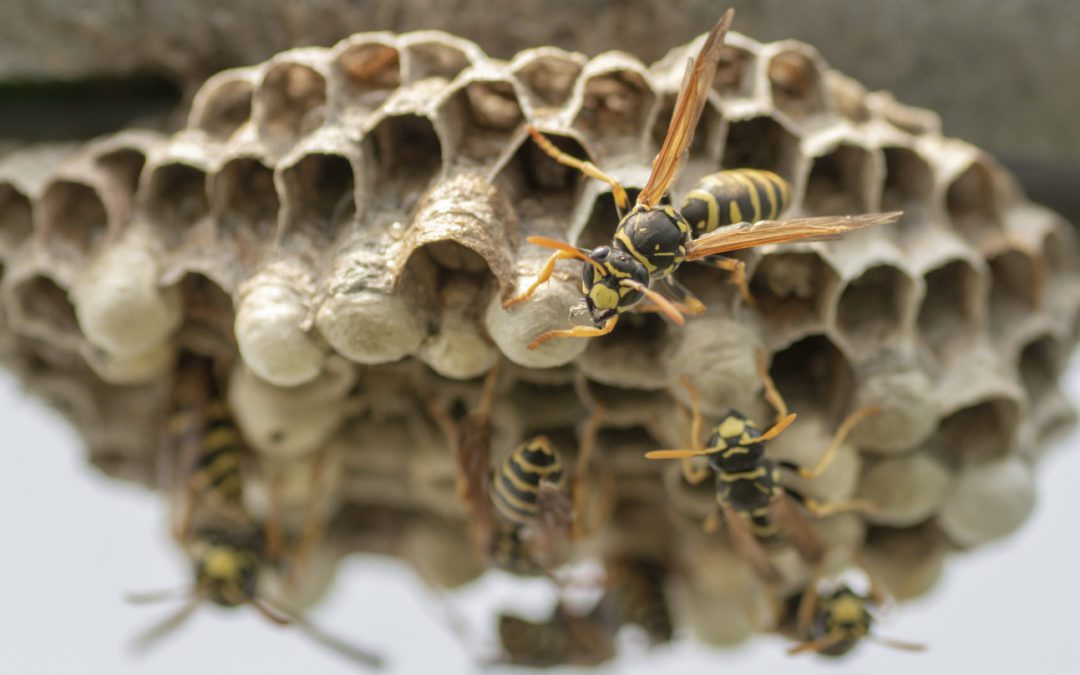
Common paper wasps have yellow stripes, which make them seem scarier than they are. Both types build their nests around buildings, tucked under eaves and in the spaces around door and window frames. They collect wood fiber from posts and plant stems to make their nests which are paper-like with hexagonal cells, hanging from a filament.
While these wasps will defend their nests, they aren’t aggressive about it. I’ve knocked down many, many paper wasp nests without ever being stung. The only time I’ve been stung by a paper wasp around here was when one accidentally made its way inside my house, and I sat on it.
The Other Yellow-Striped Wasp
There is one kind of wasp I’ve seen around here that I am not in love with. It’s yellow jackets. Now, they aren’t all bad all the time. If you’ve ever been bothered by little wasps during a picnic, it was likely yellow jackets. They were far from home, out scouting for food. If you set a little plate of your picnic treats away from your table, they’ll feast from there instead of bothering you.
But, if you’re anywhere near their home base, yellow jackets are very aggressive. If you agitate a nest, you’re likely to anger multiple yellow jackets at once, and each of them can sting you multiple times! If I find myself in a swarm of yellow jackets, I run… and then I come back after dark and kill the colony. I don’t normally kill bugs on sight, but these are the exception. They just don’t mix well with humans.
Evaluating Risk
I’ve written before about the value of risk-taking at WonderWild and the importance of my job to evaluate the available risks. Our relationship with bugs highlights many aspects of that process.
First, kids are never encouraged to interact with bugs. Yes, I share my own enthusiasm, and it can be contagious! But I don’t push anyone to handle a bug or even be closer than they’d like. If the kids find a bug indoors that they want relocated, I do it for them without hesitation.
Second, even though I’m always excited to look at a bug, I’m cautious until I’ve identified it. I share with the kids a framework of learning before interacting – an important safety attitude when dealing with unfamiliar wild plants and animals. Tennessee is home to a number of venomous caterpillars, for example. Cuteness isn’t a guarantee of safety!
Third, I stay aware of bug-related risks and intervene accordingly. Two kids recently decided to handle a carpenter bee. I advised them that it could sting them, and then I let them use their own judgement. One of them got stung, but since carpenter bee stings are pretty mild the effects were gone in a couple of hours. On the other hand, I would never knowingly let a child get anywhere near yellow jackets. The effect would be much too severe.
The Path to Falling in Love
Kids don’t have to love bugs. Bugs are often small and sneaky, fast and erratic, creepy and crawly, and a fair number of them are armed with painful weaponry! So there’s plenty to be suspicious about!
But like with so many other topics, the attitude I share makes room for love and learning to flourish. I’m curious, bringing a sense of wonder to everything. I’m excited, but I also take it slow. I never push or rush anyone.
The end result is that kids usually fall in love with bugs. Even the stingy ones and the slimy ones. Even the kids who start out afraid or squeamish. They get curious at their own pace. Comfortable in their own time.
Pretty soon they’re saying, “Hey, bee,” and marveling along with me at the many creatures who work and play here with us at WonderWild.