

I’m pretty comfortable with risks for my kids. I let them climb tall things and play with power tools. I used to assume that other parents were more safety-cautious than I am.
Then one day I went over to a friend’s house, and her kid was at the kitchen counter lighting sticks on fire! To do artwork with the charred ends! Holy *&^%! Visions of the house burning down flitted through my head. I laughed at my shattered assumptions, because I thought of my friend as a more cautious parent than me! But I would never let my kids play with fire indoors!
Risk can be hard to think about clearly since it’s so incredibly personal.
Risk is a Balancing Act
There’s no way to make an objective statement about what is too dangerous or what is safe enough.
Every decision is a balancing act between the things we want and the things we don’t want. We all make those judgments for ourselves, often without consciously realizing we’re making an assessment about risk.
We take risks because an activity provides benefits – it’s fun, it gets us money, it makes us happy, it makes our lives easier.
We avoid risks because we are afraid of things – death, injury, pain, sadness.
When it comes to our kids, of course we want to keep them alive!
When I think about maintaining my child’s life, I also think about what kind of life I am providing. Is it an anxious life? A cautious life? A boring life? A shallow life? On the other hand, is it a vibrant life? A carefree life? A passionate life? A fulfilling life?
The truth is, a completely safe life is not possible. I’ll always be choosing which dangers to expose my kids to. I do incredibly dangerous things like drive them around town in the pursuit of really boring things like grocery shopping. But I keep driving because it adds mobility, spontaneity, and variety to our lives.
I try to manage my worry about things that enrich my kids’ lives, like letting them climb things, explore the natural world, and use real tools. It’s impossible to measure the trade-off I’m making. Are they 1% more at risk of injury? 2%? Are their lives 1% more fun? 2% more creative? I don’t know. As a parent, I’m making it up as I go along, based on my own fears and values. Just like you do. What I know for sure is that a life that’s a little more risky is also a little more awesome!
As a parent, I lean on my personal values and experiences. However, as an educator I’m responsible for other people’s children. When it comes to operating a learning center like WonderWild, I have to think a little more academically about risk. Fortunately, there’s a large body of work about childhood risky play. I don’t have to guess. The research is clear about just how important risky play is to children’s development.

What Is Risky Play?
First, let’s define the activities we’re talking about.
In childhood education, risky play refers to activities that involve a sense of challenge or adventure, where children test their abilities and learn to navigate uncertainty. These are activities where children don’t know the outcome. There are some common categories, each with its own lessons to teach.
Climbing, Jumping, and Balancing
Children climb trees, go up the slide, or scale a play structure. They walk across a log or board. They jump across gaps, over obstacles, or off the top of things. These activities use their whole bodies and teach them about heights and surfaces.
Roughhousing
This is playing physically with others. It includes wrestling, chasing, shoving, tackling, and crashing into other people.
Through roughhousing children build proprioceptive skills and learn to control their bodies and moderate their strength. They explore their physical boundaries and the boundaries of others. They learn social cues, how to read body language, when to adjust to others’ needs, and how to respect others’ limits.
Exploring Natural Materials
This category is the rich world of outdoor play. It includes climbing rocks, wielding sticks, splashing in streams, looking behind and under things, trying to lift or move heavy things, exploring sand, mud, and leaves.
It’s all about discovering an unpredictable environment. It gives a full-body and full sensory experience. This kind of exploration encourages creativity and sparks a sense of wonder. It teaches how to interpret uneven ground and shifting textures.
High-Speed Play
Many children love the thrill of moving quickly. It could be running, biking, sledding, or rolling down a hill. This kind of activity develops spatial awareness, teaching children how to start, stop, and adjust their pace. The excitement of speed reduces stress, boosts mental health, and gives a healthy outlet for energy and emotion.
Tools and Loose Parts
This is the category for builders and engineers. Kids might use shovels, hammers, and other tools along with materials like wooden planks, cardboard boxes, buckets, and blocks to build contraptions. They use their imaginations, test their ideas, and can be proud of their creations.

Benefits of Risky Play
The research about risky play is clear. It’s an incredibly important part of childhood development. It’s beneficial to so many crucial aspects of how children learn and grow. Through risky play, children build skills that will serve them well through their whole lives.
Physical Development
Kids who climb, jump, run, and balance build strength, coordination, dexterity, and spatial awareness. They develop motor skills that are a foundation for their future growth. They learn how their bodies work and how to use their bodies effectively. Early practice with risky play brings bumps, bruises, and scratches, and these help them learn how to avoid serious physical injury. They expand their awareness and understanding of how their bodies and the world work together.
Emotional Resilience
Risky play brings up plenty of intense feelings like excitement, fear, frustration, and anger. It’s good for children’s emotional development to experience these feelings during self-chosen activities.
Failure is scary if you’ve never failed. But risk-taking in exciting, self-chosen ways is how you learn that failure is okay. Overcoming challenges, especially ones they set for themselves, builds resilience and confidence in a way that sticks with them for life. They learn the powerful process of trying new things, failing, and then trying again. Kids learn to trust themselves and take initiative, which leads to a positive self-image. Instead of being reliant on others to guide their choices, they build their own internal confidence in their ability to make choices.
Risky play is beneficial in the moment to a child’s stress, anxiety, and emotional regulation. And it also has a lasting impact. Children who engage in risky play are less likely to develop “avoidance habits”, making them less likely to develop anxiety disorders. It’s natural to be nervous about trying something unfamiliar. Risky play lets kids experience fear in a safe setting. When they try something scary and are okay afterwards, they have a helpful understanding about risk, danger, and their own capabilities that will serve them through their whole lives.
Learning How to Think
As grownups, we understand the potential consequences of our kids’ risk-taking. We came to that understanding through our own life experiences. If we swoop in to save kids from those consequences, it robs them of their own meaningful experiences.
When a child encounters a potential risk, makes a decision about what to do, and then experiences the results of that choice, they get it. They build problem-solving, decision-making, and risk management skills. They learn how to evaluate situations, think strategically, and predict consequences. These are the foundations of having good judgment.
There’s a physical aspect to learning to make good choices as well. Risky play teaches children important lessons about physics and about their own bodies. They learn their physical capabilities and limits. Through trial and error, they learn what feels safe and when to hold back. Knowing their own limits and the limits of the physical world keeps them from making reckless decisions later on when the stakes are higher.
Empathy, Awareness, Cooperation, and Negotiation
Some types of risky play such as building projects and roughhousing require cooperation with other kids. Together they learn that their actions have consequences to others. They learn how to pay attention to each other. They learn what might hurt themselves or another child. They learn how their movements can affect the bodies of others. They see how their actions can cause someone else hurt, anger, or sadness. They learn how to read other children’s experiences, when to keep going, and when to let up.
Through these activities children learn to negotiate rules, share space and materials, find out and respect others’ boundaries, share ideas, divide tasks, and support each other’s goals. All of these efforts strengthen social and language skills.
Evaluating Risk
Understanding the importance of risky play is one thing. Implementing safe risk-taking in a learning environment is another thing. At WonderWild, I make room for risky play, and I do it in a way that makes sense for children’s development.
First, allowing risky play does not mean “anything goes” or leaving kids on their own. Grownups are always supervising, keeping an eye out for unintended dangers and supporting kids with their activities.
It also doesn’t mean pushing kids past their own comfort levels. Children’s risky play is always chosen by them. They aren’t encouraged to take risks. Instead, they are making their own discoveries and setting their own challenges.
And it also doesn’t mean letting kids get hurt on purpose. Children’s risky play includes bumps and scratches, fears, and disappointments. But I want them to experience risk in a satisfying, rewarding, educational way – not a way that leaves them more afraid or truly injured.
How do we accomplish all this?
Supportive Supervision
WonderWild grownups let children try new challenges while staying close at hand. We hold back when possible and jump in when needed. This way kids can gain independence while also experiencing support and reassurance.
Environment Design
WonderWild is intentionally created inside and out to eliminate unnecessary hazards while offering meaningful risks.
Modeling Evaluation
When kids are wondering whether to tackle a challenge, I sometimes ask questions that guide them to think about how to decide. What’s your plan? What concerns do you have? What options are you considering? These questions encourage them to think through their options.
Managing Anxiety
Risks make grownups nervous. That’s understandable! I want to protect the kids in my care. I don’t want to see kids in pain. And I also don’t want to do more harm by trying to prevent all harm. Part of supporting children is giving them opportunities to grow, and letting them experience risk provides many of those opportunities.
Providing an environment that makes space for risk-taking includes managing my own grownup feelings. I take a deep breath and move a little closer. I remind myself that the kids actually do pretty good not hurting themselves, and that the bumps and scrapes of childhood are natural and valuable.
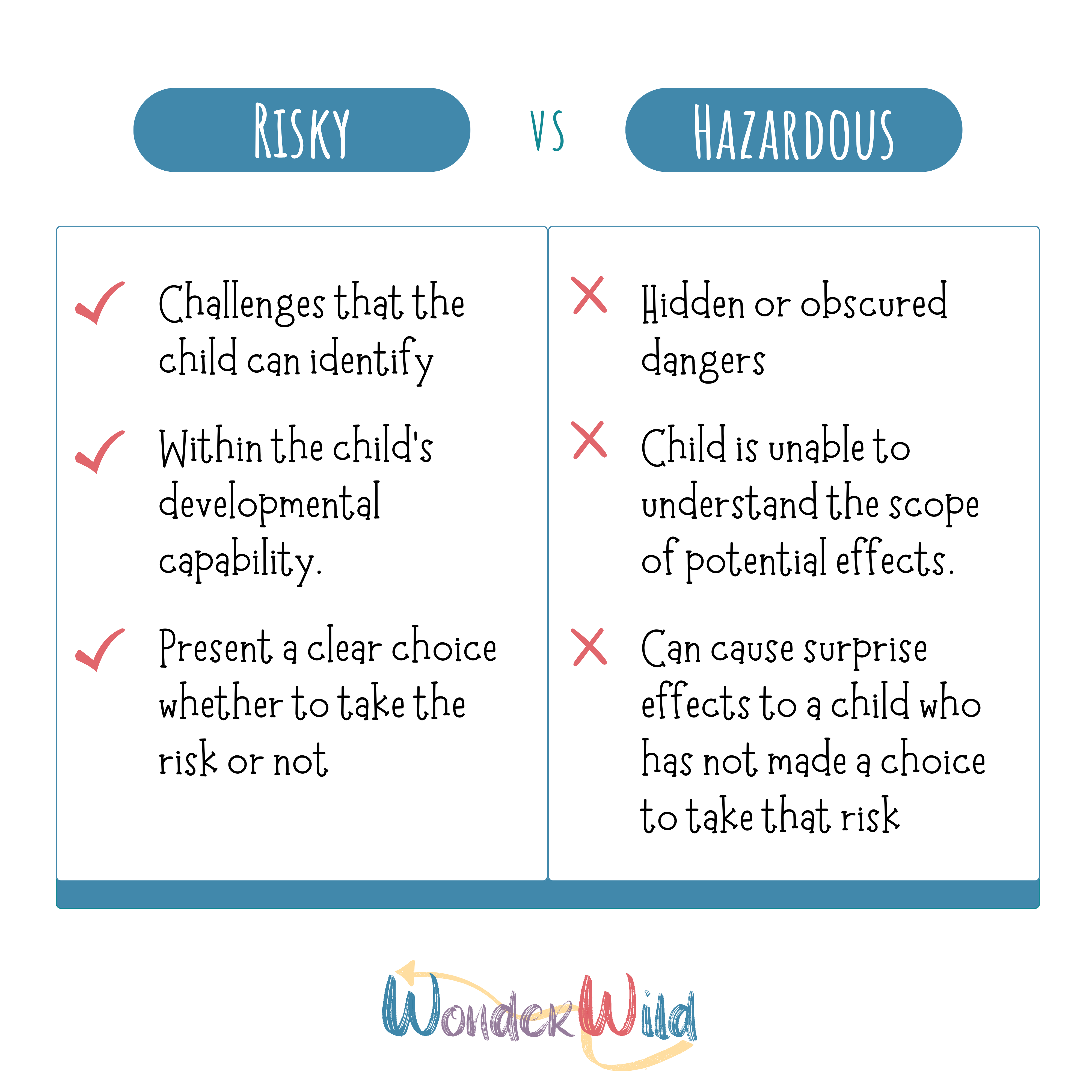
Understanding Risks vs Hazards
A risk is a challenge or uncertain situation within the child’s developmental capability where they can recognize the risk and make a choice whether to engage or not.
A hazard is a danger that is hidden or beyond the child’s understanding that could result in serious injury.
One example to see the difference is bike-riding. A child can understand the potential outcomes like fear, exhilaration, bruises, and scrapes as they make choices about how fast to ride. However, they may not be able to understand the serious potential consequences of hitting their head when they fall. As adults, we manage the hazard by requiring them to wear a helmet. Then they can safely manage the risks of riding.
Evaluating Potential Risks
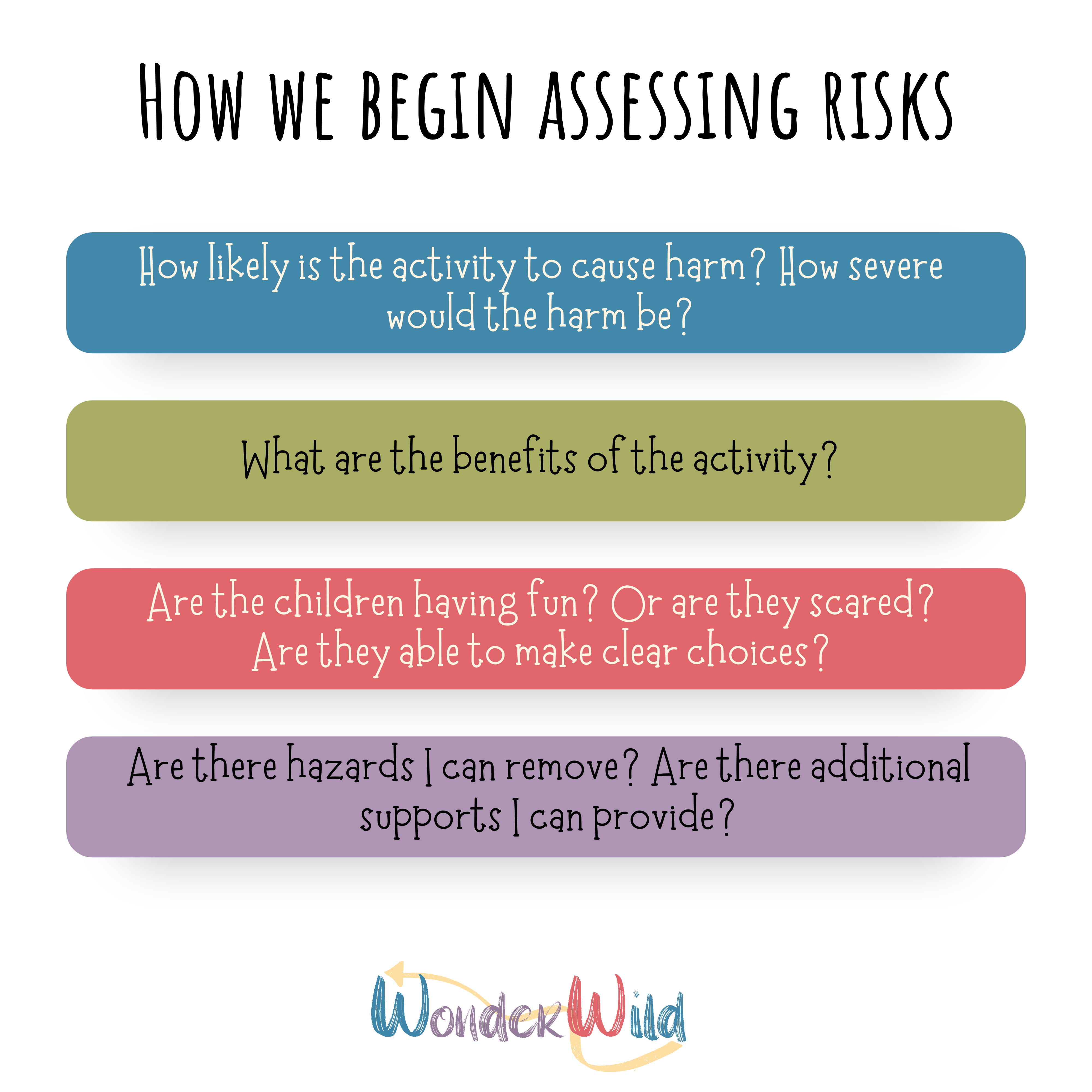
As I manage the WonderWild space and work side-by-side with the children, I continually evaluate the risks they may encounter. I ask myself:
- How likely is this activity to cause harm?
- How severe would the harm be?
- What are the benefits of the activity?
- Are the children having fun? Or are they scared?
- Are there hazards that I could remove? Sharp edges, fragile items, choking hazards, etc.
- Do the children have enough space for this activity? The right tools?
Use Your Own Judgment
After understanding the benefits of risk, setting up an environment that supports healthy risk-taking, and removing potential hazards, it’s time to let the children explore their environment and their capabilities.
One phrase I use all the time is “use your own judgment”. I don’t just want to tell kids what is and isn’t safe for them to do. I want them to develop the ability to make good choices for themselves.
Likewise, I have to use my own judgment at WonderWild. I balance the potential rewards and potential risks of the available activities. I pay attention to what the children need and what they enjoy. I make choices, experience the results, and use that information to inform my next choices.
Just like the kids, I’m learning as I go. Together we experience a life made fuller through the uncertainties and rewards of risks.